
Direct comparison of parents' and young people's perspectives: acceptance, preferred regulatory models and expected real world effects
What does this study do?
The study provides a data-based classification of how families rate a possible social media ban under 16 years of age — and which alternatives (e.g. stage-based models) are considered more practicable and fair. Particular added value is parallel perspective: Parents as gatekeepers and rule-setters as well as children/adolescents as users comparable pictured. This allows not only settings, but also Household realities Analyze (rules, feasibility, lines of conflict) in a well-founded manner.
Free download: The results presentation with all charts can be found on this page downloaded become.
Study design
- method: Online survey in the FACT Family Panel (December 2025)
- sample: n=513 parents, n=362 children/adolescents (8—17 years)
- Evaluation: In the case of multiple answers, percentages — where shown — are valid base calculated (only respondents who have seen or answered the respective list).
- Special feature: Individual survey of parents and & children/adolescents enables multi-dimensional assessment (e.g. for rules and practice from the perspective of parents and children).
Key results
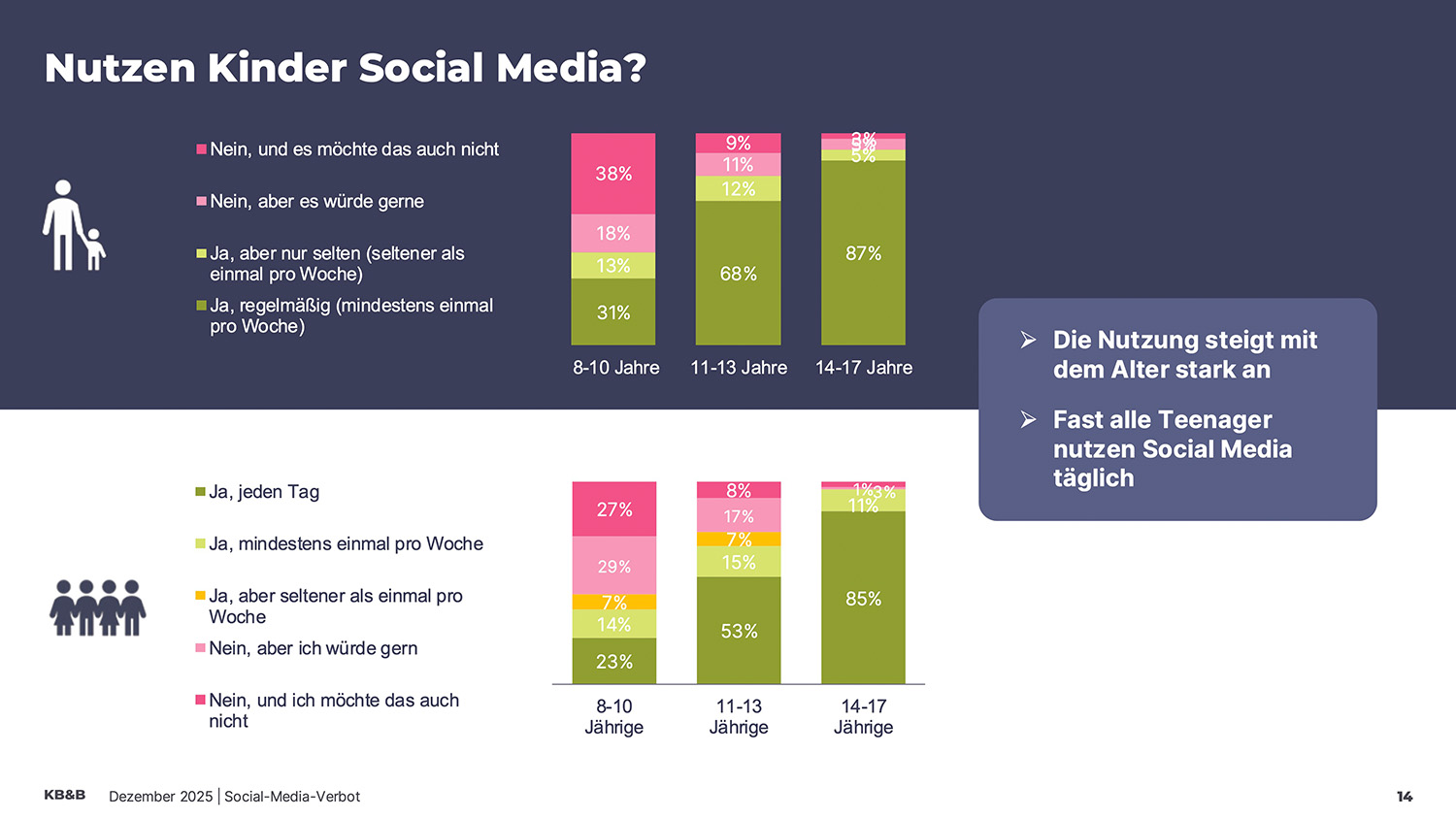
1) Use as context: Social media is highly age-driven
Use increases significantly with age — both in range and in intensity. For regulatory models, this means that a “one-size-fits-all” approach meets the realities of life of 8 to 10-year-olds differently than that of 14 to 17-year-olds.
2) Acceptance: Parents and young people rate a U16 ban differently — with a relevant compromise zone
- Parents (n=513): 58% rate a U16 ban positively, 29% “partly”, 12% negatively.
- Children/adolescents (n=362): 19% positive, 31% “partly”, 43% negative, 8% “don't know.”
Interpretation: The clear difference between parents' and young people's perspectives is expected. However, the size of the ambivalent group is decisive for strategy and communication: It signals Design space for solutions beyond a pure “yes/no” frame.
3) Preference: Stage models dominate over the total ban
When families are asked for the “best” or “fairest” solution, a consistent pattern emerges:
- Parents (n=513):
- 42% Prefer a Stage model with limited functions under 16
- 24% prefer a complete ban under 16
- Children/adolescents (n=362):
- ”limited features“is the most common single option (24%)
- Just as relevant:”No new rules — family decides“(24%)
Marketing and communication perspective: Families are clearly favoring Risk reduction through specific mechanisms (feature design, protection defaults) instead of blanket exclusion logic.
4) Household reality: Rules exist — suitability for everyday use is decisive
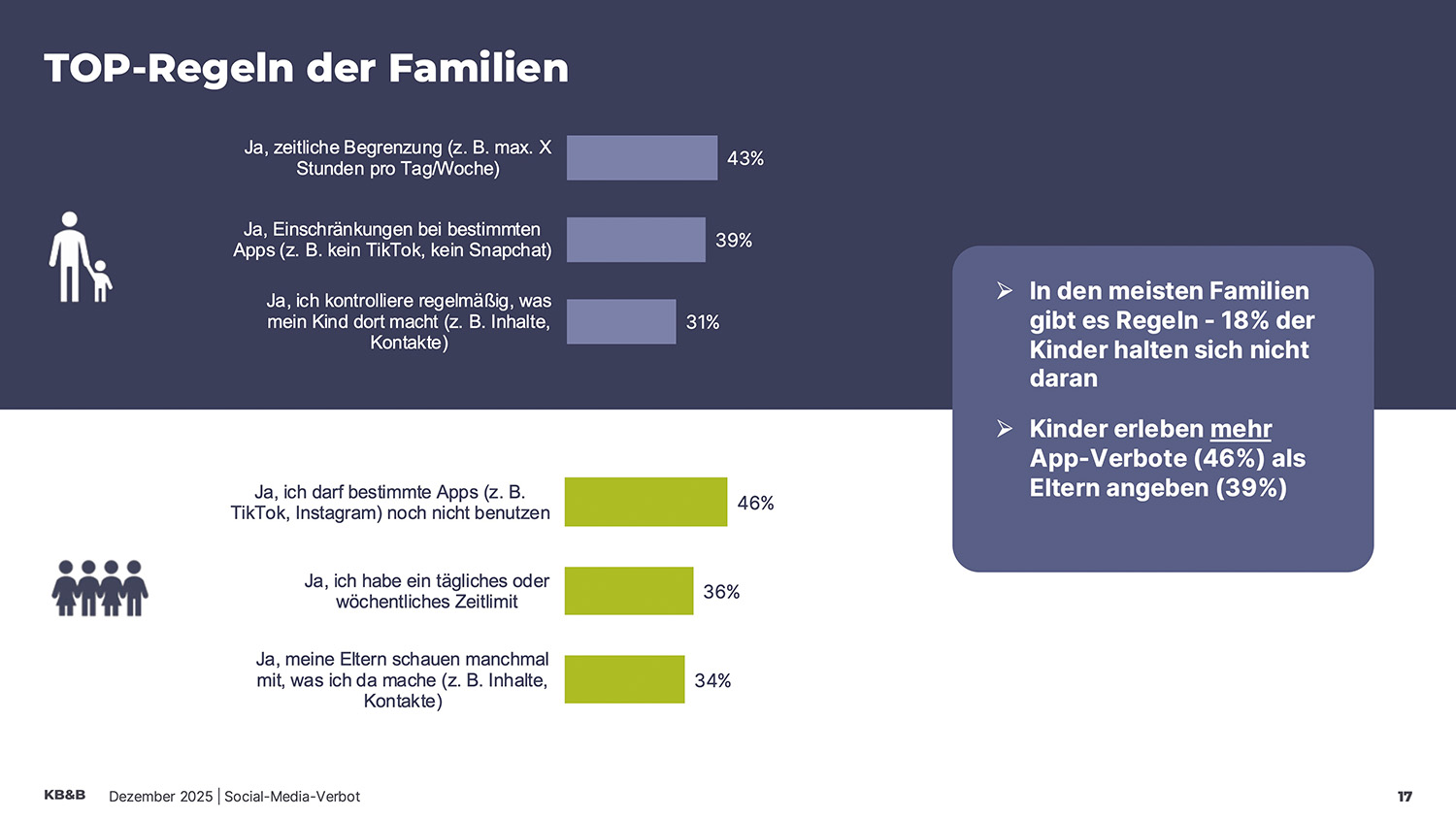
- Parents (base n=513): 73.5% report rules in the budget (rule base n=377), 24.2% no fixed rules.
Among parents with rules (valid base n=377), time limits, app restrictions and monitoring dominate. - Children/adolescents (base n=362): 79.8% report rules (rule base n=289), 14.6% no rules.
Among children with rules (valid base n=289), in addition to time limits and app restrictions, there are also: 22% openly state that rules are not always followed.
Interpretation: It is not only relevant to the debate whether rules exist, but Where they reach limits in practice — particularly in older age groups.
5) Effectiveness question: Secret evasion is expected as likely (valid base)
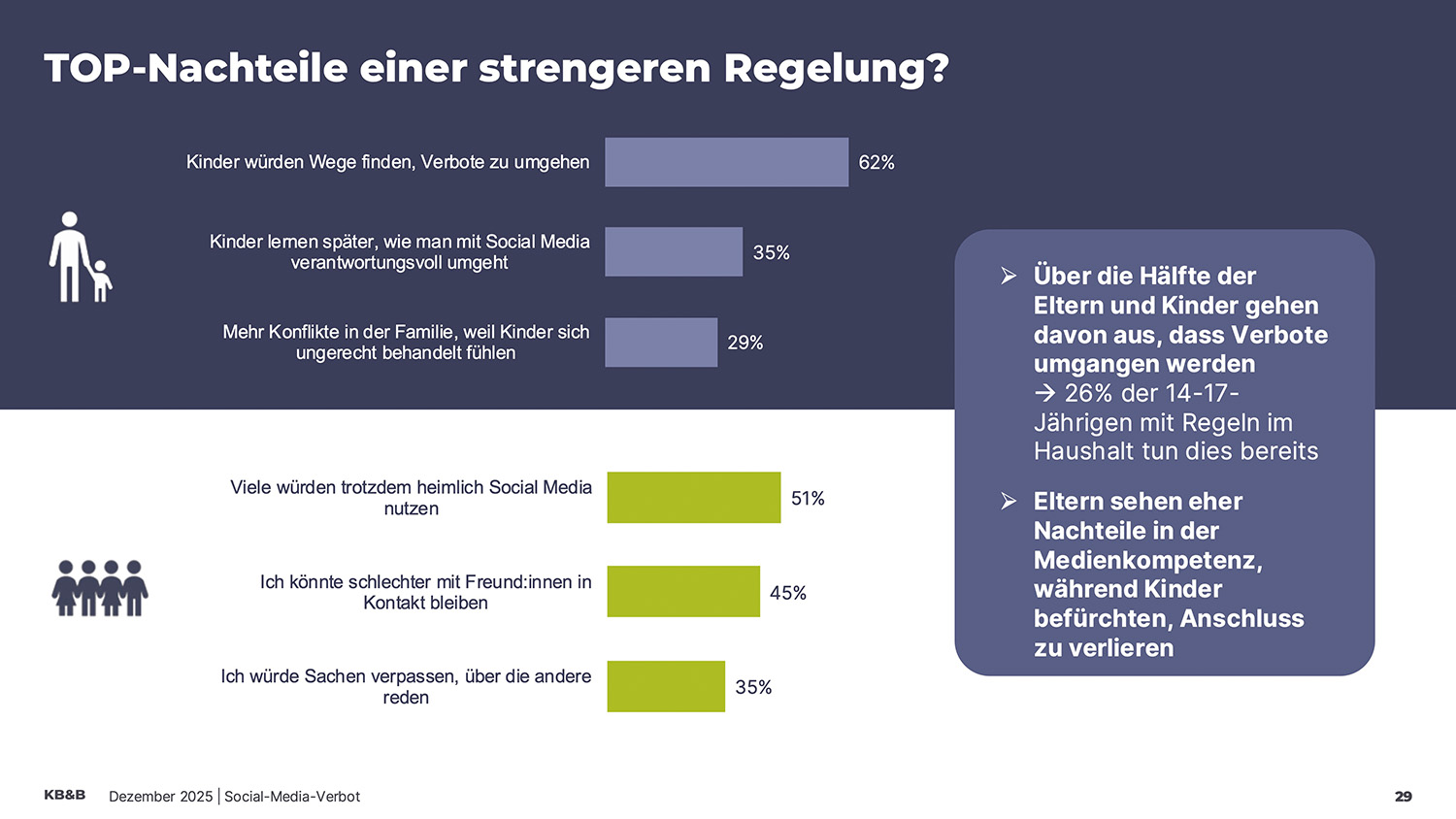
The most common drawbacks relate to implementability/compliance:
- 75% of parents expect workaround (valid base: disadvantages named, n=424)
- 65% of children/adolescents calculate with secret continued use (valid base: disadvantages named, n=287)
Additional classification: Risk of the “disclosure barrier”
From a prevention and family perspective, a side effect is relevant: If use slips into a “secret” zone, this can increase the hurdle of seeking support from trusted persons in the event of negative experiences (bullying, sexting pressure, unwanted contacts, cybergrooming) — because those affected are afraid of anger or sanctions. For protection concepts, it is therefore crucial that rules and measures with low-threshold help structures be linked (“help without an initial penalty”).
6) Responsibility: Shared Responsibility — Young people prioritize participation
- parents Responsibility is often viewed as an interplay between parents, government and platforms.
- children/adolescents Clearly prioritize “children & parents together.”
Interpretation: Protection is provided not only in terms of content, but also via legitimacy rated. With increasing age, negotiation and participation become more important.
Classification for practice and communication
1) Strategic core: Preference families stage-based protection mechanisms versus “on/off” logics.
2) Feasibility is the test: Expected evasion makes it clear that regulation without mechanics suitable for everyday use is perceived as incomplete.
3) Think about Help-Seeking: Protection must also take effect when things go wrong — without additional barriers due to fear of sanctions.
4) Consider target group logic: Parents as gatekeepers and children as users need to be addressed differently — on a common topic.
Download: Results presentation
Frequently asked questions (FAQ)
1. How do the opinions of parents and young people differ about a social media ban under 16?
While 58% of the parents surveyed rate a ban positively, only 19% of young people agree; the majority of young people (43%) reject it, with a relevant compromise zone (“part/partly”).
2. What is the data basis for the study on the social media ban (2025)?
The study is based on an online survey in the FACT Family Panel from December 2025 with a sample of 513 parents and 362 children or adolescents aged 8 to 17 years.
3. Why is a blanket social media ban considered problematic for everyone under 16?
The study shows that use is highly age-driven (“reach and intensity”); a regulatory model must therefore differentiate between the realities of life of 8 to 10 year olds and that of 14 to 17 year olds.
4. What is the particular methodological approach of this social media study?
The added value lies in the “parallel perspective”, in which parents (as rule-setting) and children (as users) are presented in a directly comparable way in order to analyze not only attitudes, but real household realities and lines of conflict.
5. What is the level of opposition to a social media ban among young people?
According to the study, 43% of young people between 8 and 17 years of age rate a strict U16 ban negatively, while a further 31% are undecided (“part/partly”).